Ethical culture as a foundation for value creation
Ethical culture starts with strong leadership
and good governance
Ethics and integrity are about what leaders demonstrate, prioritise and translate into decisions and systems. It becomes real in everyday behavior and it shows up in how people:
raise dilemmas early
challenge decisions - even when it costs popularity
speak up without fear
take responsibility
feel committed to the organisation
reflect on decisions
learn from mistakes
keep developing their moral awareness and judgment
translate values into daily practice
contribute to a safe, open and ethical culture
Strong organisations cultivate ethical cultures. These do not emerge by accident. They are built deliberately through strong leadership, good governance and a long-term approach.
Organisations are credible when their vision of ethical conduct is reflected
in leadership and everyday decisions.
Especially when it becomes difficult.
How? With an integrated approach
Ethics and integrity should not be managed through fragmented initiatives, but developed as a coherent whole. Leadership, culture, values and informal practices must connect with governance structures, policies, processes and decision-making.
Treating ethics as isolated activities rarely leads to lasting change. An ethical culture develops when these elements reinforce one another and are embedded in everyday leadership and behaviour.
This requires more than a code of conduct or a once-a-year e-learning. It requires an integrated approach that fits the organisation’s context.
Continuous learning
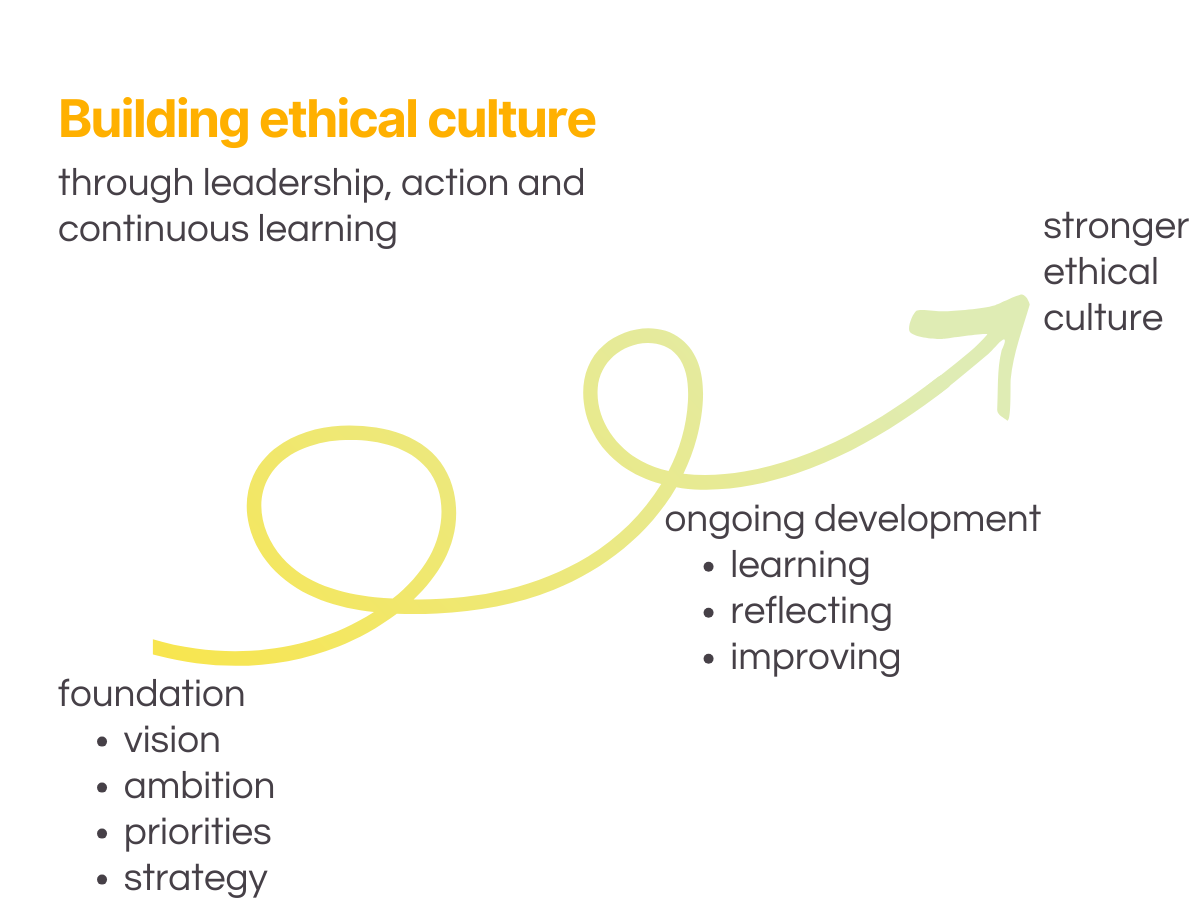
Building an ethical culture is a continuous process and a shared learning journey. Organisations grow by gradually strengthening their foundations, aligning leadership, governance and practice, and creating a culture where ethical awareness and responsible decision-making continue to evolve.
This starts with a strong foundation which includes a clear vision, ambition, priorities and a strategy that fits within the organisational infrastructure and its overall mission.
Building a strong foundation
Key elements of an integrated approach to ethics and integrity
-
A successful anchor for any ethical strategy is a clear vision, what you believe and what the organisation stands for. Develop an organisation-specific vision on ethics in which you describe:
your core activities, mission and purpose
the importance of doing the right thing, for the organisation, industry and the planet
clearly the desired culture and ethical climate you aim to create
expected behaviour
norms and values and their importance: what does the organisation stand for?
how to apply the core values in practice: how do they guide your decisions?
-
Translate your vision into a clear level of commitment and direction. Ambition is about how far you want to go. Define how seriously the organisation wants to develop its ethical culture, what it aims to achieve over time and how this contributes to your organisation, the industry, perhaps even society at large, the planet?
A clear ambition clarifies:
the level of maturity the organisation aims to reach
how leadership should play a role in demonstrating and reinforcing ethical behaviour
expections placed on leaders, employees and teams.
Where are you now and where do you want to be in 5 or 10 or 50 years?
-
Strategy turns the vision and ambition into a structured and coordinated approach: it answers the ‘how?’.
A clear strategy for ethics and integrity defines:
strategic priorities for strengthening the ethical culture, governance and leadership
concrete objectives over several years - consider using sub-objectives (e.g. leadership, governance, skills)
roles and responsibilities of leadership including integrity functions and essential governance bodies
activities needed to execute: what supports your strategy? Think about leadership development, dialogues, policy upgrades, communications.
how progress will be monitored, evaluated and reported: how does your continuous learning cycle work?
Connect your long-term ambition and goals with concrete actions: your strategy tells you how to organise the journey towards an ethical culture.